
Reviewed by Michael Vance, CFA, Senior Portfolio Strategist | Last Updated: June 13, 2026
Imagine two cars parked side-by-side. Both have the exact same engine, the same horsepower, and are destined for the exact same town 30 years down the road. But one car charges you a micro-toll every single time you tap the gas pedal, while the other forces you to pay a lump sum just to open the driver’s side door.
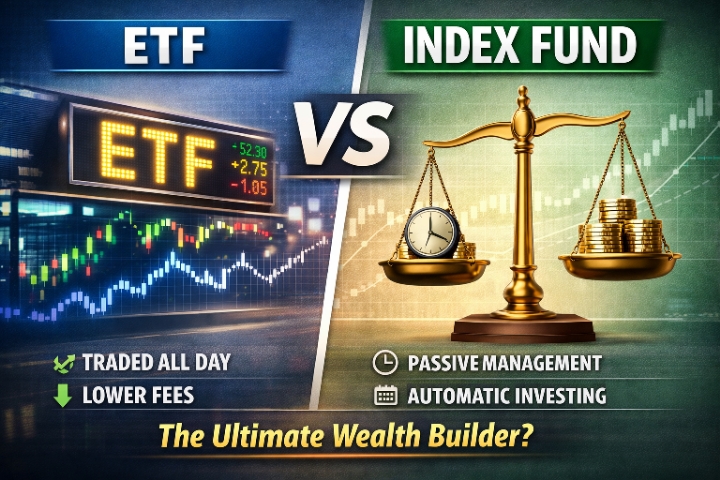
This is the hidden reality of the ETF vs Index Fund debate.
To the untrained eye, Exchange-Traded Funds (ETFs) and Index Mutual Funds look identical. Both are designed to step away from reckless stock picking. Instead, they passively track broad market benchmarks like the S&P 500 or the Total Stock Market index. Both deliver the magic of diversification, turning a single purchase into fractional ownership of hundreds of corporate titans.
Yet, beneath the hood, their DNA is completely different. The vehicle you choose dictates your transaction fees, your automation capabilities, and how much money you will inevitably hand over to the government on tax day. If you want your money to compound optimally for the next ten, twenty, or thirty years, understanding these microscopic structural differences is critical.
The Core Machinery: How ETFs and Index Funds Diverge
To understand which vehicle deserves your hard-earned capital, we must examine how they operate in the live market.
* Real-World Scenario: Sarah’s Tuesday Morning Panic
It’s 10:30 AM on a volatile Tuesday. The stock market is dipping on temporary geopolitical news. Sarah wants to buy the dip. She logs into her brokerage account. If Sarah uses an ETF, she can buy shares instantly at $145.20 per share, capturing the price at that exact second. If Sarah uses an Index Fund, she places her order now, but nothing happens. Her trade will execute at 4:00 PM EST, buying in at the final Net Asset Value (NAV) calculated at market close—regardless of how wildly the price swung at lunchtime.
The fundamental difference lies in tradability. ETFs are traded like individual stocks on an open exchange. Their prices fluctuate by the millisecond based on real-time supply and demand. Index funds, conversely, are traditional mutual funds. They trade exactly once per day after the closing bell rings.
For a day trader, this makes the ETF the undisputed king. But for a long-term investor looking at a multi-decade horizon, intraday price fluctuations are nothing more than background noise. What matters to the long-term wealth builder are structural friction points: costs, automation, and tax efficiency.
Cost Structures and the Automation Trap
Historically, ETFs boasted significantly lower expense ratios—the annual management fee charged by the fund—than traditional index mutual funds. Today, major brokerages like Vanguard, Charles Schwab, and Fidelity have engaged in a race to the bottom, rendering expense ratios nearly identical for core broad-market indices.
However, total cost of ownership goes far beyond the headline expense ratio.
The Hidden Costs of ETFs
When you purchase an ETF, you face two structural costs unique to exchange-traded assets:
* The Bid-Ask Spread: The difference between the highest price a buyer is willing to pay and the lowest price a seller is willing to accept. For highly liquid, massive funds tracking the S&P 500, this spread is fractions of a penny. For niche or sector ETFs, it can silently erode your purchasing power.
* Premium/Discount Risk: Because ETFs trade on an open market, the share price can occasionally deviate slightly from the actual value of the underlying stocks, meaning you might pay a tiny premium when buying or accept a discount when selling.
The Financial Discipline of Index Funds
Index funds bypass these market mechanics. You buy directly from the fund house at absolute NAV. There is no spread and no premium.
More importantly for long-term investors, index funds natively excel at behavioral automation.
* Real-World Scenario: David’s “Set-It-and-Forget-It” Empire
David wants to save $500 every single month from his paycheck. He sets up an automatic transfer into an S&P 500 Index Fund. Every month, without him lifting a finger, exactly $500 is pulled from his checking account and fully invested—down to fractional pennies. If David used a traditional ETF, many legacy brokerages would require him to log in manually during market hours, check the current stock price, and manually execute a buy order for a whole number of shares, leaving uninvested cash sitting idle in his account.
While a growing number of modern fintech brokerages now offer automated recurring ETF purchases and fractional shares, the native structure of an index mutual fund remains universally friction-free across standard banking and retirement setups like 401ks.
The Silent Killer: Tax Efficiency in an ETF vs Index Fund Portfolio
If your investments are sitting safely inside a tax-sheltered account—like a Roth IRA, traditional IRA, or a workplace 401(k)—the tax differences between these two vehicles are completely irrelevant. But if you are building wealth within a taxable brokerage account, this section could save you tens of thousands of dollars over a lifetime.
When evaluating an ETF vs Index Fund portfolio for taxable accounts, ETFs possess a massive, legally hardwired advantage: the “In-Kind” creation and redemption mechanism.
Traditional Index Fund:
Investor Cash Out ──> Fund Manager Sells Stocks ──> Capital Gains Tax Triggered For ALL Shareholders
Exchange-Traded Fund (ETF):
Investor Shares Out ──> Institutional Swap (“In-Kind”) ──> No Stock Sale ──> No Tax Triggered
When an investor wants to cash out of an index mutual fund, they send a redemption request to the fund manager. To hand that investor their cash, the fund manager must frequently sell physical shares of the stocks held within the fund. If those stocks have appreciated in value, a capital gain is realized. By federal law, that capital gain must be distributed at the end of the year to everyone who owns shares in the fund—even if you didn’t sell a single dime of your portfolio.
ETFs elegantly sidestep this trap. When you want to sell your ETF, you don’t force the manager to liquidate underlying stocks. You simply sell your shares directly to another investor on the open market.
Furthermore, large institutional market makers handle big redemptions through an intricate, tax-free swap of shares called an “in-kind” exchange. Because no underlying stocks are sold for cash by the fund itself, capital gains distributions are incredibly rare. You only owe capital gains taxes when you choose to sell your ETF shares for a profit.
ETF vs Index Fund: The Ultimate Long-Term Verdict
* Real-World Scenario: Marcus Evaluates His Strategy
Marcus is 28 years old and mapping out his wealth journey to age 60. He decides to split his strategy based on the structural strengths of both assets. For his workplace retirement account, he chooses a broad-market Index Fund because it completely automates his monthly contributions and reinvests dividends smoothly without manual calculations. For his extra personal savings in a taxable brokerage account, he routes his cash into a low-cost broad-market ETF to shield himself from the annual capital gains tax distributions that plague mutual funds.
To choose the optimal vehicle, weigh your investment platform, account type, and psychological style against the structural differences of each asset.
An Exchange-Traded Fund (ETF) is unique because it trades continuously throughout the day during active market hours, operating much like an individual stock on an open exchange. This setup provides superior tax efficiency because the fund uses specialized creation and redemption mechanisms that rarely trigger internal capital gains. While major brokers offer commission-free trading for these funds, you remain subject to minor market costs like bid-ask spreads. Furthermore, automated investing with ETFs can vary significantly by brokerage, often requiring a modern platform to smoothly handle automated recurring purchases or fractional shares.
An Index Mutual Fund operates on a much different rhythm, trading exactly once per day at 4:00 PM EST based on the final closing market prices. Because trades occur directly through the fund company at its absolute Net Asset Value, you bypass the hidden frictions of market spreads, though some funds require a higher initial investment to get started. While these mutual funds have lower tax efficiency due to potential annual capital gains pass-through distributions in taxable accounts, they hold a massive edge in behavioral discipline.
They provide completely seamless, universal automation that allows you to schedule recurring deposits down to the penny across nearly any standard investment or retirement platform.
The Final Takeaway Note
In the grand scheme of your financial journey, choosing between an ETF and an index fund is a high-class problem. Both vehicles are excellent tools that beat actively managed funds over long horizons. The single most critical step is simply getting your money into the market so compounding can do its heavy lifting.
If you crave absolute simplicity, automated recurring transfers, and want to remove the temptation of watching ticking stock charts, go with an Index Fund. If you are investing outside of a retirement account and want absolute protection from unnecessary tax bills, lean heavily toward an ETF. Pick the strategy that aligns with your behavioral style, turn the automation on, and let time take care of the rest.
Frequently Asked Questions
1. Do ETFs pay dividends like index funds?
Yes, if the underlying stocks held within an ETF or index fund pay dividends, those payouts are collected by the fund and passed along to you. ETFs typically distribute dividends quarterly as cash into your brokerage account, where you can choose to manually or automatically reinvest them. Index mutual funds offer natively seamless automatic dividend reinvestment programs (DRIPs).
2. Can you lose all your money in an ETF or index fund?
While all investing carries risk, losing all your money in a broadly diversified ETF or index fund tracking a major index like the S&P 500 is mathematically improbable. For your investment to drop to zero, every single one of the top hundreds of corporations in the market would have to simultaneously go bankrupt and close their doors permanently.
3. Which has higher fees, an ETF or an index fund?
Historically, ETFs held a reputation for lower expense ratios, but today the management fees are virtually identical among major index providers. However, ETFs can carry minor external costs like bid-ask spreads and potential brokerage transaction costs. Index funds do not have spreads but may occasionally carry higher initial minimum investment thresholds to open an account.
4. Are ETFs better for a retirement account or a taxable account?
ETFs are exceptional for taxable accounts due to their unique structural tax efficiency which mitigates annual capital gains distributions. In a tax-sheltered retirement account like an IRA or 401(k), this tax edge disappears completely. In those accounts, an index fund may be preferred for its native ability to execute flawless automated recurring investments.
5. Can I convert my index funds into ETFs without paying taxes?
Certain investment management firms, most notably Vanguard, offer a patented structure that allows investors to convert eligible mutual fund share classes into their corresponding ETF equivalents tax-free. However, this is provider-specific and cannot be performed universally across different fund families or standard brokerages without initiating a taxable sale.
6. Is the S&P 500 an ETF or an index fund?
The S&P 500 itself is neither; it is a stock market index that tracks the performance of 500 of the largest publicly traded corporations in the United States. However, financial institutions build both ETFs (like SPY or VOO) and Index Mutual Funds (like VFIAX) designed to mirror the exact performance of that index.
7. Why do some financial advisers prefer index funds over ETFs for long-term clients?
Advisers often favor index funds because they remove the emotional and behavioral temptation to time the market, as prices only update once a day. They also facilitate effortless dollar-cost averaging through hands-free recurring deposits, forcing investors into disciplined wealth-building habits without needing to manage intraday market execution.
8. Do index funds or ETFs have better historical returns?
If an ETF and an index fund are tracking the exact same market index with identical expense ratios, their long-term returns will be virtually identical. Any minor variance over time typically comes down to transaction execution tracking errors, bid-ask spread friction, or whether dividends were immediately reinvested or sat in cash.
References & Financial Sources
Fidelity Investments: Understanding the Differences Between Mutual Funds and ETFs. Retrieved from https://www.fidelity.com
Vanguard Group: ETF vs. Mutual Fund Cost Comparison and Tax Structures. Retrieved from https://www.vanguard.com
Investopedia: In-Kind Redemptions and Creation Mechanisms in Exchange-Traded Funds. Retrieved from https://www.investopedia.com
U.S. Securities and Exchange Commission (SEC): Mutual Funds and ETFs – A Guide for Investors. Retrieved from https://www.sec.gov